Ireland's Military Story

Tag: Kildare County Council

  • Restoration of Memorial to Forgotten Celbridge Figure

    Restoration of Memorial to Forgotten Celbridge Figure

    Restoration of Memorial to Forgotten Celbridge Figure – Sir Gerald Dease

    We have spoken about Sir Gerald Richard Dease K.C.V.O. previously and his memorial outside St. Patrick’s Church, Celbridge. He is all but forgotten in Celbridge; the Celtic Cross is commonly mistaken for a marker to a priest. The cross in many ways highlights how quickly history can fade with time. With the help of Kildare County Council Heritage Office and Celbridge Parish Office we have begun a restoration and conservation project on the Dease memorial cross. The works are being carried out by Bracken Monuments. 

    Born on 7 July 1831 Dease was a prominent person in the late 19th century in Ireland. He was Justice of the Peace for Counties Kildare and Meath, a  Director of the Great Southern & Western Railway and appointed a Director of the Bank of Ireland (the predecessor to the Central Bank) and its Governor between 1890 and 1892. On 27 July 1881, Dease was appointed Major and Honorary Lieutenant Colonel of the 4th Battalion, Princess  Victoria’s (Royal Irish Fusiliers). He also served as the Chamberlain to the Lord-Lieutenant of Ireland and was involved in the organisation of several royal visits to Ireland. For his excellent service he was Knighted in 1897, being made a Companion of the Royal Victorian Order in 1900 and a Knight Grand Cross of the same order on 11 August 1903. Locally Sir Gerald Dease served on Kildare County Council on several occasions and served as Chairman of the Celbridge Board of Guardians [the Workhouse] (today Colourtrend paint factory) and within both bodies he became an advocate for improved conditions for the poor. He lobbied extensively for the creation of a National University to which Catholics would have full access. It is for  these efforts he was most remembered. 

    Following his death on 18 October 1903, the people of Celbridge raised the funds and erected the Celtic Cross memorial in recognition of this remarkable man. Soon when people walk by they will clearly see the name Sir Gerald Richard Dease K.C.V.O. There is still a little more to do on the restoration. We will keep you posted.

    Thank you to Kildare County Council Heritage Office and Celbridge Parish Office for their support.

  • Recording the Story of the 18pdr with Sgt Robert Delaney

    Recording the Story of the 18pdr with Sgt Robert Delaney

    Recording the Story of the 18pdr with Sgt Robert Delaney

    Photos by John O’Byrne and Michael Coyne

    First published on 26 August, 2022. Updated 1 March 2023.

    Delighted to release our production of: The Four Courts QF 18-pounder ‘9168’ Field Gun – From Restoration to Museum Display. This video was recorded on location last August in the Curragh Military Museum last August with Sgt Robbie Delaney, Irish Defence Forces Ordnance Corps. This video tells the story of the recently restored Ordnance QF 18-pounder Field Gun ‘9168’; one of the very same that fired the opening shots of the Irish Civil War in June 1922. Variants of the Ordnance 18-pdr served throughout the Great War – primarily with the British Artillery Regiments, in the early years of the National Army following the establishment of the Irish Free State, and with the Irish Defence Forces’ Artillery Corps up until the 1960s. This particular gun was sold off in the 1950s and disappeared across the Atlantic. As it turned out it stood guard outside a diner in Virginia, United States until historian Kenneth Smith-Christmas came across it and recognised it as an Irish Army 18-pdr. From there he contacted Lar Joye in the National Museum of Ireland , not long after a team was on its way over to inspect the gun. Brought home to Ireland the ‘Ivy Patch Gun’ as it was known has now been fully restored to as it was in 1922 by the team at the Ordnance Corps in the Curragh Camp. This is the story of The Four Courts QF 18-pounder ‘9168’ Field Gun – from restoration to museum display. In this video Sgt Robbie Delaney takes viewers through the history and service of the gun and the restoration and conservation process. An incredible undertaking and a credit to all the team involved. The restoration and conservation project is complemented by a exhibition in the Curragh Military Museum, depicting the firing on the Four Courts 28-30 June, 1922.

    The 18pdr Field Gun is currently on display in the National Museum of Ireland Collins Barracks, Dublin.

    Thank you to Military Archives, Kenneth Smith-Christmas, and British Pathé. This project was supported by Kildare Decade of Commemorations and The Dept. of Tourism, Culture, Arts, Gaeltacht, Sport and Media.

    You can red the full story of the Ivy Patch Gun prior to its restoration and its journey back to Ireland in Kenneth Smith-Christmas article by clicking here.


    Big thank you to Sgt Robert Delaney Ordnance Corps and the team at the Curragh Military Museum.

  • Company Sergeant Liam White (Rtd) – McKee Barracks Coy – UNFICYP – UNEF II

    Company Sergeant Liam White (Rtd) – McKee Barracks Coy – UNFICYP – UNEF II

    Company Sergeant Liam White (Rtd) McKee Barracks Coy

    UNFICYP – UNEF II

    Veterans are a key to any military story; they are the people who served, they are the people who were there. Recording their story helps preserve our past and can give us lessons for the future. There isn’t a community in Ireland where you will not meet an ex-service man or women. For our Kildare Veterans and In the Service of Peace project, we met up with retired Company Sergeant Liam White, who has lived in North Kildare with his family since 1986. Many people in Celbridge may remember Liam and his wife Patricia from when they ran the Order of Malta unit in Celbridge in the 1990s.
    Liam, who is originally from Dún Laoghaire, first joined the Irish Defence Forces/ Óglaigh na hÉireann in 1964 when he enlisted with B Company, 21st Infantry Battalion FCÁ. He has fond memories of marching in the annual 1916 commemorations during those early years. In 1967 Liam joined the Permanent Defence Force and was sent down to the Curragh Camp for recruit training. After passing out Liam was posted to McKee Barracks Company; the support unit for Defence Forces Headquarters. At this time the Army was only 7,500 strong. It was not long before Liam found himself on an NCO course and on 26 December 1968, he was promoted Corporal. With the outbreak of the Troubles the Defence Forces were put on high alert. Reservists were called up, and centres established to take in potential people fleeing the hostilities. When the border was established, Liam recalled periods when soldiers were meeting themselves coming off duties and patrols. The army had to expand due to the Troubles and initially there was no relief. Patrols, road blocks, and watching or hearing shootings along the border between Republicans and British Forces became the norm. On one occasion Liam collapsed after not sleeping for four days straight. One of the pictures Liam kept shows him having Christmas dinner while on the border.

    In 1970 Liam was then assigned as a Cadre Training NCO with the 21st Infantry Battalion FCÁ which took him all over the battalion area of South Dublin and North Wicklow. His first deployment overseas was with the 20th Infantry Group, United Nations Peacekeeping Force in Cyprus (UNFICYP) in April 1971. During this period tensions were high between the two communities on the island; the mission brought new challenges for the young Corporal. Promoted Sergeant, Liam deployed overseas again in April 1974 with the 26th Infantry Group, United Nations Emergency Force (UNEF II) in the Sinai. Not a blade of grass could be found in the blistering hot desert. The Irish men found themselves once again in between two heavily armed factions and vast areas of unexploded ordnance and mines. The unit were only settling in when the Dublin and Monaghan bombings took place at home and the unit was rapidly brought home by the end of May 1974.

    Liam served in various appointments in Defence Forces Headquarters including with An Cosantóir – the Defence Forces magazine and the Chief of Staff’s Branch. Liam retired from the Defence Forces in 1989 as a Company Sergeant. Thank you to Liam for telling his story and for his long service at home and overseas.

    This recording is part of our Kildare Veterans series and In the Service of Peace – exploring Ireland’s contribution to world peace: a project in conjunction with The Organisation of National Ex-Service Personnel, The Irish United Nations Veterans Association and The Association of Retired Commissioned Officers. This production was made possible with support by Kildare Library Services, Kildare Creative Ireland and the Community Foundation.

  • Recording Ireland’s Contribution to World Peace

    Recording Ireland’s Contribution to World Peace

    Recording Ireland’s Contribution to World Peace


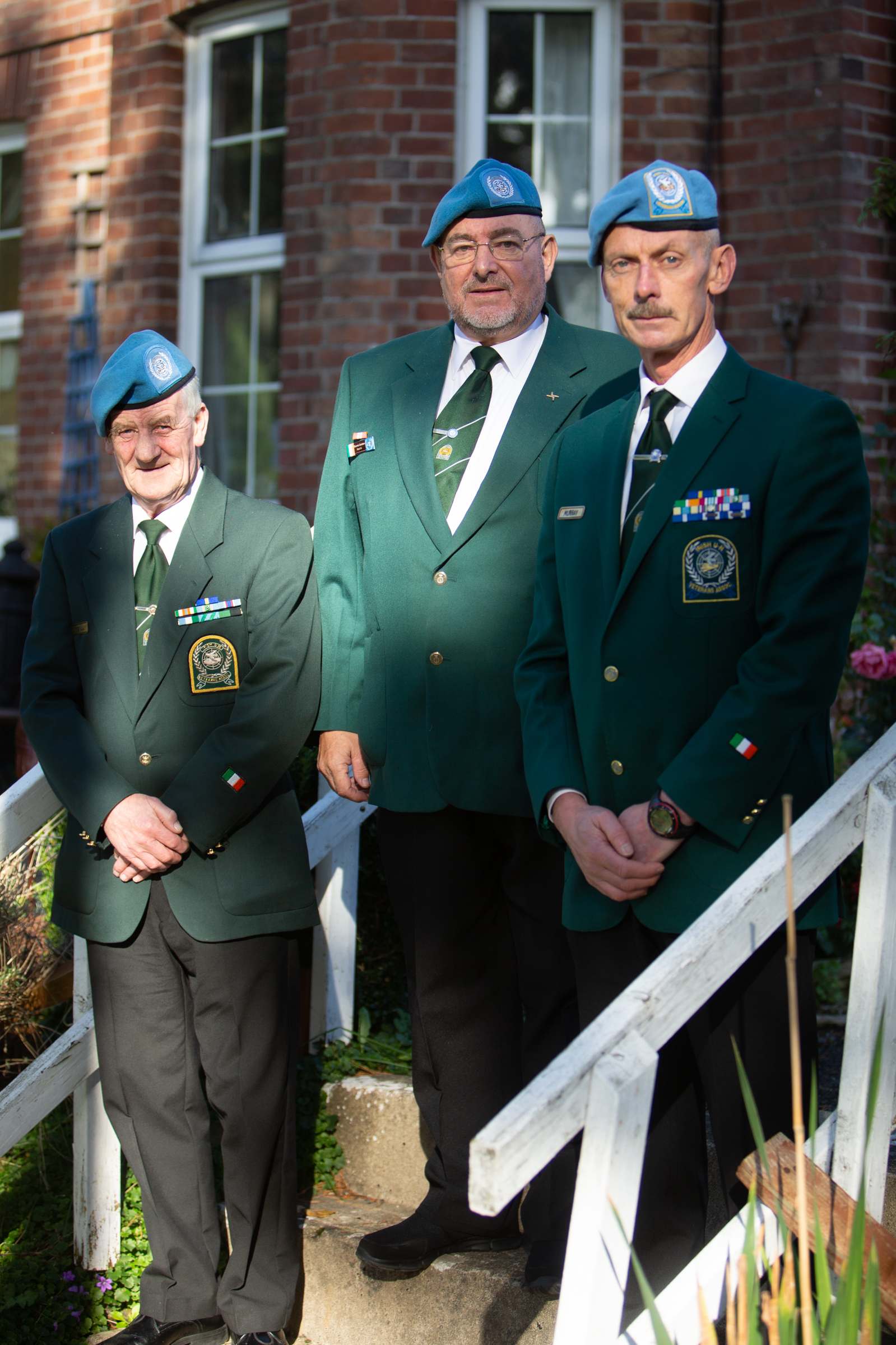
    As part of a project to record Ireland’s contribution to world peace, we visited Post 11, the Irish United Nations Veterans Association (IUNVA), in the Curragh Camp Co. Kildare. There we met and spoke with Irish Defence Forces veterans Company Quartermaster Sergeant Tony O’Reilly, Sergeant Major John Murray, and Sergeant Denis Gratten; who between them served on 34 missions around the world. Both John and Denis are Kildare men all their lives, while Tony came to the Curragh in 1974 from Waterford and has called it his home ever since.

    The three men have unique perspectives on service overseas due to their diverse skillsets including logistics, communications, and crime scene investigation. They served in missions such as: United Nations Iran-Iraq Military Observer Group (UNIIMOG); United Nations Interim Force In Lebanon; United Nations Operation in Somalia II (UNOSOM II); European Union Monitoring Mission (EUMM) Bosnia and Herzegovina; and with the International Security Assistance Force (ISAF) mission in Afghanistan. It was remarkable to hear the evolution of peacekeeping and overseas operations spanning almost 50 years.
    Even though retired the veterans of IUNVA are still giving back and helping in the local community and supporting veterans.

    IUNVA Post 11 veterans Tony O’Reilly, Denis Grattan, and John Murray. Photo by John O’Byrne.

    Thank you for your service.


    This project is supported by Kildare County Council Heritage Office, Creative Ireland, Irish United Nations Veterans Association, the Organisation of National Ex-Service Personnel, and the Association of Retired Commissioned Officers.

  • Two Kildare Veterans Tell Their Story

    Two Kildare Veterans Tell Their Story

    Two Kildare Veterans Tell Their Story

    Interview with Sergeant Sharon McNamara and Sergeant Major Billy Redmond

    On Friday 7 August we met up with two retired Kildare veterans to record their stories: Sergeant Sharon McNamara and Sergeant Major Billy Redmond.
    Sharon comes from a long line of military service with grandfathers on both sides serving in the early days of Óglaigh na hÉireann / Irish Defence Forces. Growing up on the Curragh, joining the Amy was a natural progression. In 1981, a decision was made to recruit women under general enlistment. Along with forty other young ladies, Sharon found herself part of the Defence Forces first all-female recruit platoon. As this was a new chapter in the history of the Defence Forces Sharon had some enlightening stories to tell. At that time women could not serve in combat units. Even guard duties were off the list. This did not take long to change as Sharon explained: ‘in many ways we pioneered the way for those that came after us’. Sharon primarily served in the Administration School and the Curragh Command Headquarters. Retiring after 21 years’ service, Sharon now works for The Kerry Group in Naas.

    Sergeant Sharon McNamara about life in the Defence Forces with the first all female platoon in 1981. (Photograph by John O’Byrne)

    Sergeant Major Redmond is a well-known veteran from Kilcullen, who regularly writes and gives talks on his 45 years’ service in the Defence Forces. Billy joined in the late 1950s and served with the Signal and CIS Corps. Billy spent ten years on missions with the United Nations Peacekeeping, three tours in the Congo, two in Cyprus, and nine in South Lebanon. Billy’s first overseas tour was to the Congo with the 32nd Infantry Battalion and was able to give us insight how signallers operated in those harsh conditions. No smart phones back then, it was old style Morse Code. Impressively Billy can still tap out 22 words a minute.

    Thank you to Jim Brady from ONE Ireland in Kildare for arranging the interviewees and to NC & JO’B Photography Studio & Gallery in Rathangan for the use of their facilities and support. Covid 19 safety precautions were observed during our interviews.

    Sergeant Major Billy Redmond describing the situation in the Congo in the early 1960s. (Photograph by John O’Byrne)

    This project is sponsored by County Kildare Heritage Office and Creative Ireland.

  • Interview with Dr. Cathal Berry TD

    Interview with Dr. Cathal Berry TD

    Interview with Dr. Cathal Berry TD

    Project: Kildare’s Veterans’ Story

    Taking part in our Kildare’s Veterans’ Story project today was Óglaigh na hÉireann / Irish Defence Forces veteran Dr Cathal Berry TD in Newbridge, Co. Kildare. Cathal is an Independent TD for the constituency of Kildare South. Cathal is a father, husband, doctor, veteran and is a resident of Portarlington, Co. Laois. He is married to Orla and is the proud father of their young children Tom and Katie.

    Prior to becoming a TD, Cathal spent 23 years in the Irish Defence Forces. He entered military service in with the Cadet School, Military College, Curragh Camp in 1995. After a tough 21 months training he was commissioned into the Infantry Corps. During his time in the Defence Forces, he spent six years in the Army Ranger Wing (ARW) and served overseas in the Balkans, Africa and the Middle East. In 2008, Cathal led an ARW unit in Chad. He later took a self-funded career break to qualify as a medical doctor in Royal College of Surgeons in Ireland

    He subsequently worked in the HSE Ireland hospital emergency departments all over the country and then returned to the Defence Forces where he was appointed head of the Military Medical School in the Curragh, Co. Kildare. He retired from service at the rank of Commandant.

    Dr Cathal Berry TD with two members of his team: Lesley Walsh and Philip Coy, both of whom are also former members of the Defence Forces. Lesley, a Newbridge native, spent 24 years in the Defence Forces, serving in the 3rd Infantry Battalion, DFTC, and Chief of Staff’s Division, DFHQ. Philip (Busty) is a Curragh native serving 24 years in the Defence Forces primarily in the Military Detention Unit and the Transport Company in the DFTC. (Photo by John O’Byrne)
    Wesley Bourke interviewing Dr Cathal Berry TD . (Photo by John O’Byrne)


    This supported by Kildare County Council Heritage Office and Creative Ireland.

  • Celbridge’s Lost Son – Private Robert Beveridge

    Celbridge’s Lost Son – Private Robert Beveridge

    Celbridge’s Lost Son – Private Robert Beveridge

    Over the past year and half we have been researching for our first project – Celbridge’s Military Story. This project has led us down history trails we never envisaged. A project by the History Squad in Scoil Na Mainistreach on Celbridge’s casualties of the Great War led us to Major William Dease – son of Sir Col. Gerald Dease – who in turn had recruited local men into the Remounts in 1914. By pure chance we came across a casualty of the Great War not on the Celbridge war dead list: Private Robert Beveridge 28th Remount Squadron who is buried in Naas, County Kildare. Robert died on 25 January 1919 in the Curragh Military Hospital. The Kildare Observer confirmed he had been given a military funeral with honours paid by the Royal Dublin Fusiliers. Robert’s military records have not survived and no birth cert exists. Last year we inconclusively connected Robert to Celbridge through census records: the census listed a Robert Beverage, foster child with the Lennon family in Celbridge and later a labourer. Digging up several conundrums we came to multiple dead ends to conclusively prove the two Roberts were one of the same.

    Not wanting to leave it at that we endeavoured to find out more. With the help of historians Drs Ann Mathews and Brendan O’Shea, local historians Jim Tancred and George Bagnall, Graham Hughes and Martin Whyte of St. Corban’s cemetery, and David Grant (www.cairogang.com) the story of Robert began to come together piece by piece. Through documents such as Robert’s Soldier’s Effects we were able to link the Private Beveridge buried in Naas to Celbridge and the Lennon family. As it turns out the Lennon family are still in the area and proudly remember Robert. We met the Lennon family – who still poses Robert’s medals and his photograph – and paid tribute at his grave. The History Squad had the key all along. 100 years ago, the Lennon family were the stuart’s of the Dease estate in Celbridge Abbey and Kilmacredock.

    We will be bringing you Robert’s full story in the coming months.

    Nora and Eoghan Lennon at the grave of Private Robert Beveridge in Naas. (Photograph by Wesley Bourke)

    This project is sponsored by Kildare County Council Heritage Office.

  • In Defence of North Kildare

    In Defence of North Kildare

    In Defence of North Kildare

    Tony Maher recollects his time in the Fórsa Cosanta Áitiúil (FCÁ)

    Today we had the pleasure of meeting former reserve Corporal, Tony Maher from Celbridge. During the 1960s Tony was a member of Maynooth Platoon, C Company, 7th Infantry Battalion FCÁ.

    Tony Maher at his home in Celbridge. (Photo by Michael Coyne)

    During the Emergency period (1939 – 1946) and the Cold War (1947 – 1991) Ireland remained neutral, however, the threat was still real. During these two periods the reserve elements of the Irish Defence Forces were greatly expanded. Nearly every village in the country had a platoon size or more of reservists stationed there. Celbridge in North Kildare was no different. During the Emergency the North Dublin Battalion of the Local Defence Forces had a Company in North Kildare, with a platoon in Celbridge, Maynooth, and Kilcock. Following the Emergency and the establishment of Fórsa Cosanta Áitiúil (FCÁ), this transitioned to the North Dublin Battalion FCÁ and in 1959, C Company 7th Infantry Battalion FCÁ.

    At the time Tony lived in Lexlip and told us some amazing stories of Lexlip and the surrounding areas in the 1950s and 1960s. Tony grew up not far from where Sergeant Hugh Gaynor lived and had very fond memories of him. Sadly Sergeant Gaynor was one of the nine Irish peacekeepers killed in the Niamba ambush in the Belgium Congo on 8 November 1960.

    Tony’s rifle trophy.

    The reservists met several evenings during the week and at the weekends. The headquarters for the C Company platoons were as follows: the Methodist Church (now Cunninghams Funeral Directors), Celbridge; the town hall in Maynooth; and the old church off the centre in Kilcock. Life in the reserve infantry back then was defined by marching and the .303″ Lee-Enfield rifle, which Tony remembers like it was yesterday. He proudly still has his rifle competition trophies. Drill, local exercises, training in Gormanstown and the Glen of Imaal, St. Patrick’s Day Parades, and 1916 commemorations were the annual routine. Thankfully Tony was an avid photographer and he has kept a remarkable collection of the reservists in North Kildare.

    Movie star Tony in German uniform on the set of the Blue Max 1965.

    It wasn’t all drill and more drill. During this time the FCÁ got called upon to provide extras for the movie the Blue Max; directed by John Guillermin and starring George Peppard, James Mason, Ursula Andress, Karl Michael Vogler, and Jeremy Kemp.. During 1965 Tony found himself in a German World War I uniform and charging across no-man’s land in the Wicklow mountains. Tony managed to smuggle his camera on set.

    Tony’s story has been recorded as part of Kildare’s Veterans’ and ex-service personnel Story. This project is supported by Kildare County Council and Creative Ireland.

    The history of a lot of these reserve units has been lost. We are tying to build up the history of the reserve in North Kildare and would really like to talk to members of C Company. Please drop us a line.

  • Kildare’s War of Independence Story

    Kildare’s War of Independence Story

    Kildare’s War of Independence Story

    Wesley Bourke discussing the War of Independence in County Kildare with historian James Durney.

    The War of Independence (1919 – 1921) turned Ireland upside down. In a series for Kildare Decade of Commemorations we will be telling the story of this period in Kildare with the help of local historians we will be telling the stories of attacks in Naas, Leixlip and Maynooth. On Friday last we met author and historian James Durney who took us through the events of 20 August, 1920.

    Directly across the road from the Leinster Leader and the Court Hotel on Main Street Naas is Haydes Café. In 1920 it was the home and boot and shoe store of Jimmy White a known active IRA (Irish Republican Army) volunteer. Following an ambush at Greenhills, Kill, by the local IRA unit led by Thomas Harris (Bureau of Military History Deposition by Major Patrick Colgan) in which two RIC (Royal Irish Constabulary) constables were left dead, Jimmy White was listed as suspect number 1. Seeking revenge two lorries of Black and Tans (Royal Irish Constabulary Special Reserve) from the Curragh headed into Naas. However, their local intelligence was not the best. They were looking for a boot and shoe shop. In one of histories ironies the Black and Tans were presented with two boot and shoe shops; one was Jimmy Whites and the other was Boushells across the road beside the Leinster Leader right on the corner leading to the laneway to the Naas RIC barracks (Naas Court Hotel). Boushells was mistakenly chosen and burned.

    This project is funded by Kildare Decade of Commemorations. Thank you to James Durney and to Haydes Café Naas.
    Featured in this Story: Leinster Leader Haydes Naas Café, Naas Court Hotel, Kildare County Library Service Kildare County Council and Kildare Heritage

  • Celbridge’s Military Story – Private Robert Beveridge A Son of Celbridge?

    Celbridge’s Military Story – Private Robert Beveridge A Son of Celbridge?

    Private Robert Beveridge – A Son of Celbridge?

    Celbridge’s Military Story took us to Naas, County Kildare this week. For the past few weeks we’ve been researching Celbridge and the Great War. Extensive work has been done on this by Dr. Fionnuala Walsh, by the History Squad in Scoil na Mainistreach, and the students of Salesian College. Today there are now two Great War memorials in Celbridge, honouring those who lost their lives in that conflict; one in Christ Church and one in Salesian College. The History Squad that unearthed a connection with Celbridge and the Remount Service. They reported that local man, Major William Dease, had recruited Celbridge men into this branch of the Army. It was on this trail that led us to Private Robert Beveridge of the Army Remount Service, who died in the Curragh Military Hospital on 25 January 1919.

    Robert’s name popped up as a casualty of the Great War, buried in Saint Corbans Cemetery in Naas, County Kildare. He is listed as: R/066621 Private R. B. Beveridge, 28th Remount Squadron, the Royal Army Service Corps. Son of Mrs. M. Beveridge, of Limerick Road, Naas, Co. Kildare.

    Producer Wesley Bourke at the grave of Pte Robert Beveridge in Corban’s Cemetery Naas, Co. Kildare. (Photo by Michael Coyne)

    There is no mention of a connection with Celbridge. As it is an unusual name we had a look at the census. In the 1901 Census, there is a Robert Beverage, 6 year old boy, living with the Lennon family at Main Street, Celbridge, Co. Kildare. He was noted as a “boarder”. In the 1911 Census, Robert Beverage was a 17 year old Agricultural Labourer, living with the Lennon family at Kilmacredock Upper, Celbridge, Co. Kildare, and still noted as a “boarder”.

    Our link to Robert Beveridge in Naas is only speculative as the trail ends here. Recent information indicates that Robert was a foster child of James Lennon and Norah née Somers Lennon.

    We do know from the surviving medal index card of Private Robert Beveridge buried in Naas, that he was awarded the 1915 medal. Indicating he joined possibly around the start of the war.

    He died at the Military Hospital at the Curragh, from appendicitis and liver abscesses. Hopefully more information will come to light and we can confirm that Robert Beveridge buried in Naas is the same Robert Beverage from Celbridge listed in the early census.

    This project is supported by Kildare County Council.