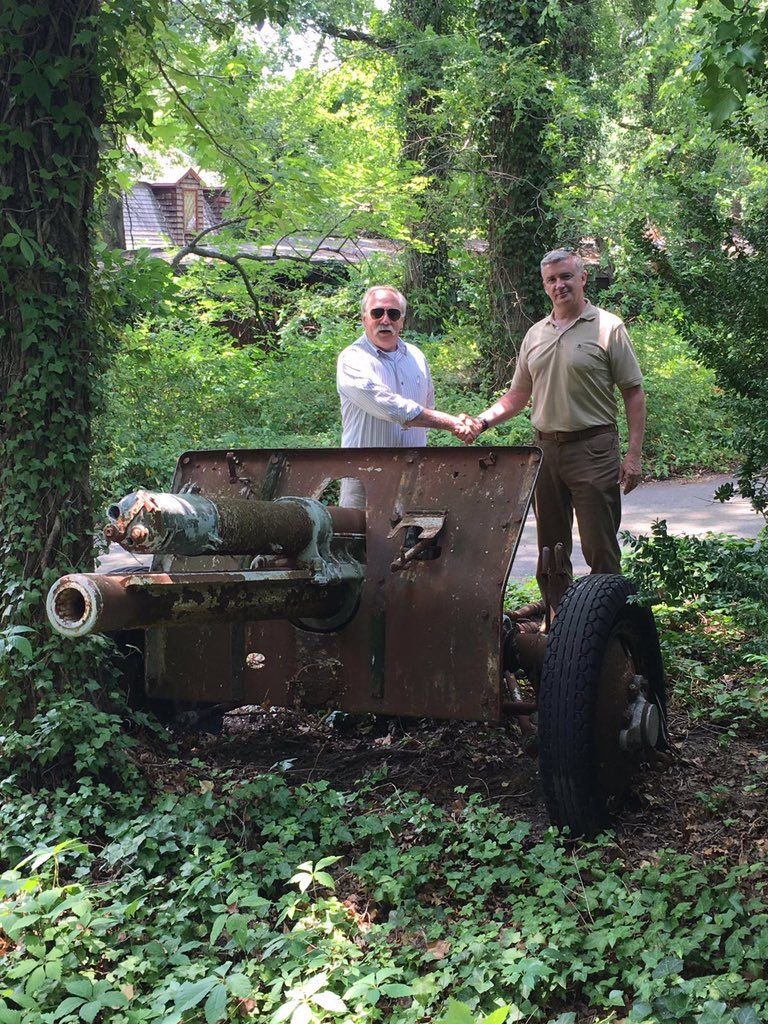
Recording the Story of the 18pdr with Sgt Robert Delaney
Photos by John O’Byrne and Michael Coyne
First published on 26 August, 2022. Updated 1 March 2023.
Delighted to release our production of: The Four Courts QF 18-pounder ‘9168’ Field Gun – From Restoration to Museum Display. This video was recorded on location last August in the Curragh Military Museum last August with Sgt Robbie Delaney, Irish Defence Forces Ordnance Corps. This video tells the story of the recently restored Ordnance QF 18-pounder Field Gun ‘9168’; one of the very same that fired the opening shots of the Irish Civil War in June 1922. Variants of the Ordnance 18-pdr served throughout the Great War – primarily with the British Artillery Regiments, in the early years of the National Army following the establishment of the Irish Free State, and with the Irish Defence Forces’ Artillery Corps up until the 1960s. This particular gun was sold off in the 1950s and disappeared across the Atlantic. As it turned out it stood guard outside a diner in Virginia, United States until historian Kenneth Smith-Christmas came across it and recognised it as an Irish Army 18-pdr. From there he contacted Lar Joye in the National Museum of Ireland , not long after a team was on its way over to inspect the gun. Brought home to Ireland the ‘Ivy Patch Gun’ as it was known has now been fully restored to as it was in 1922 by the team at the Ordnance Corps in the Curragh Camp. This is the story of The Four Courts QF 18-pounder ‘9168’ Field Gun – from restoration to museum display. In this video Sgt Robbie Delaney takes viewers through the history and service of the gun and the restoration and conservation process. An incredible undertaking and a credit to all the team involved. The restoration and conservation project is complemented by a exhibition in the Curragh Military Museum, depicting the firing on the Four Courts 28-30 June, 1922.
The 18pdr Field Gun is currently on display in the National Museum of Ireland Collins Barracks, Dublin.
Thank you to Military Archives, Kenneth Smith-Christmas, and British Pathé. This project was supported by Kildare Decade of Commemorations and The Dept. of Tourism, Culture, Arts, Gaeltacht, Sport and Media.
You can red the full story of the Ivy Patch Gun prior to its restoration and its journey back to Ireland in Kenneth Smith-Christmas article by clicking here.
Big thank you to Sgt Robert Delaney Ordnance Corps and the team at the Curragh Military Museum.
The Ivy Patch Gun Possible ‘Four Courts’ Irish Field Gun Returns Home
By Kenneth L. Smith-Christmas, Lar Joye, and Commandant Stephen MacEoin
The ‘Ivy Patch’ gun, loaded for shipment back to Ireland, under the supervision of Lieutenant Colonel Paul Carey.
A potentially very significant 18-pounder Mark II field gun arrived home in Ireland last year, after having been gone for more than fifty years. This gun was made in Scotland during World War I for the British Army, and it could very well have later played a significant role in Irish history, before being sold as surplus scrap metal to an American international arms dealer in 1959, and then finally ending up in a patch of English ivy at a now-shuttered dinner theater in northern Virginia, not far from Washington D.C. The story of its discovery and return is a tale of coincidence and chance, as well as energetic efforts on both sides of the Atlantic.
The Irish 18-pounders
At 4am on 28 June 1922, two 18-pounder field guns (serial numbers as yet unknown) opened fire on the Four Courts in Dublin, Ireland, in an action that signalled the beginning of one of the most heartbreaking episodes in Ireland’s long and turbulent history—The Irish Civil War. Six 18-pounder guns (two Mark I’s and four Mark II’s) had been ‘loaned’ by the British Army to the fledgling National Army of the Provisional Irish Government, in order to quell the growing rebellion against the newly established Irish government. A visceral and implacable division had erupted between the Irish nationalists who had spent years fighting the ‘Forces of the Crown’ to bring independence to Ireland. One side, the ‘Free Staters’, supported the 1921 Anglo Irish Treaty with the British government that gave Ireland the same status as other Dominions, like Canada and Australia, but not a complete break from the British Empire. The opposing faction, soon to be dubbed the ‘Irregulars’ or ‘anti-treaty’, would not be satisfied with anything but full independence, and a group of them had holed up in Dublin’s Four Courts building, an imposing Georgian edifice alongside the River Liffey. The Provisional Government demanded their surrender, but when it was refused, they opened fire.
After three days of shelling with light ‘wire-cutting’ shrapnel rounds from these two guns, the defenders surrendered when their munitions magazine exploded, and the building caught fire. Recent historical research indicates that the explosion was more likely caused by the rebel forces mining the building, rather than from the bombardment. Sadly, the building also contained the Public Records Office, as well as the Four Courts, and it, too, was destroyed. The end result was not only the destruction of a beautiful building, but also the loss of 700 years of archives. Although the building was later rebuilt and re-opened as a judicial court, its loss is still felt today. However, the end of this siege just marked the beginning of a sad, and brutal, conflict that tore close long-time friendships and families asunder, until it ended some eighteen months later. Indeed, except among academics and historical enthusiasts, the subject is still avoided by many people in Ireland today, as the memories are too searing. The Irish Free State came into effect on 6 December 1922.
Between 1926 and 1941, the Irish Department of Defence acquired additional Mark I and Mark II, as well as more modern Mark IV, 18-pounder guns from Britain. During World War II, the British government also supplied Ireland (on 29 December 1937, under the new constitution, the Irish Free State was renamed Ireland) with other military gear and weapons. Concurrently, this ‘Ivy Patch’ Mark II cannon, like all of Ireland’s artillery, was modernised with pneumatic tyres, as well as with a braking system for towing behind motor vehicles. It then continued to serve in the Irish Army, until 1958, when it was sold for scrap metal as part of a shipload of artillery and machine guns to the relatively new firm of International Armament Corporation (Interarmco) of Alexandria, Virginia, (a small city, just down the Potomac River from Washington D.C.). Interarmco ‘Interarmco’, also later known as ‘Interarms’, was founded in the mid-1950’s. Its organiser and president, Sam Cummings, was a savvy and resourceful weapons purchaser who found ‘untraceable’ arms for certain governmental agencies during the 1950’s, and also acquired surplus military arms abroad for civilian sales in the United States. His travels and dealings took him all over the globe, and while in Argentina, he approached the government there and offered to empty its warehouses of obsolete military weapons at ‘bargain basement’ prices. Accordingly, he proposed an offer that the Argentines accepted, and old brick warehouses along the waterfront streets of what is now upscale ‘Old Towne’ Alexandria, Virginia, were soon packed to the ceilings with thousands of M1891 and M1909 Argentine Mauser rifles, hundreds of machine guns, swords, and even 7,000 steel cavalry lances, as well as 542 assorted cannons of all types. The Argentine cannons, mostly of German manufacture, but also from other countries, eventually were dispersed in the local area, across the United States, and around the world. As was the case with the rifles, they were sold at very low prices. Coincidentally, this huge purchase took place in 1959, a few months after the ‘Ivy Patch’ 18 pounder gun arrived in Alexandria on a Finnish cargo ship, the SS Finnmerchant, from Dublin, as part of a shipload of other obsolete surplus Irish cannons (among which were Mark I and Mark II 18-pounders, 4.5” howitzers, and anti-artillery guns, as well as some 60-pounders) and more than 850 machineguns.
This 4.5 inch howitzer, sitting on the waterfront of Alexandria, Virginia, was one of the cannon in the same 1959 shipment of war material from Ireland that contained the “Ivy Patch” 18-pdr gun.
The ‘Ivy Patch’ Gun
The owner of a then recently-opened dinner theatre and restaurant, overlooking the banks of the Occoquan River a few miles to the south of Alexandria, purchased this 18-pounder gun from Interarmco and set it up among his outdoor gallery of other antiques—old fire engines, farm machinery, and curiosities. Among the other curiosities on the premises was a US-made World War II searchlight, also painted battleship gray like the 18-pounder gun, as well as other similarly painted cannons. There the gun sat in an ivy patch for the next forty-plus years, until the ivy had nearly covered it, and the once-thriving dinner theater declined.
In February 2006, Ken Smith-Christmas, one of the staff curators at the planning office for the forthcoming National Museum of the U.S. Army, was sent to England, in order to, among other tasks, inspect the restoration work that was being done to an original World War II LCVP (landing craft, vehicle, personnel) wooden landing craft from the Normandy Invasion of 1944. A private firm near Portsmouth, England, was doing the restoration. After checking out the work that had been done to the landing craft, Ken accompanied the owner on a tour of his facility. When Ken noticed a British 18-pounder gun under restoration, he casually asked about it, since he had a life-long interest in World War I. The owner replied that it was being restored for the military exhibition at the National Museum of Ireland in Dublin, and that it was one of the guns that had fired on the Four Courts in 1922.
Concurrently, this ‘Ivy Patch’ Mark II cannon, like all of Ireland’s artillery, was modernised with pneumatic tyres, as well as with a braking system for towing behind motor vehicles. It then continued to serve in the Irish Army, until 1958
Ken was very impressed to hear that, as Irish military history had also been a favourite topic of his for many years, and he then asked the owner where the gun had been found. Ken heard the owner’s reply of ‘Argentina’, and that really piqued his interest, since he had grown up in the Alexandria area, and remembered the many fenced lots on the Alexandria waterfront that held all sorts of cannons from Argentina. In fact, when Ken was still in high school, he had tried to buy one of these cannons—a 1903-dated Krupp 77mm field gun— from a man who had acquired it from one of these lots, and had it sitting in front of his house in a neighbouring subdivision. At any rate, Ken also knew of the plans to establish a military museum in Dublin, as he had met its director, Lar Joye, the previous summer at a conference of the International Committee of Museums of Arms and Military History (ICOMAM) that was held in Canada, and he had eagerly listened to Lar’s presentation about the new ‘Soldiers and Chiefs’ exhibition that was coming soon to Dublin’s former Collins Barracks. However, Ken didn’t give the gun in the restoration yard much further thought, and simply looked forward to seeing it in the new museum whenever he could get an opportunity to visit Dublin again.
A few years later, Ken was stuck in one of the inevitable evening rush hour traffic jams while driving home from his museum planning office in Fort Belvoir, Virginia. While waiting for the line of cars ahead of him to finally move, Ken noticed that he was across the highway from the Lazy Susan Dinner Theater, and recalled that this locale had played a part in a book that he had been reading about Confederate guerillas during the American Civil War. There had been a firefight between Colonel John Mosby’s partisan rangers and a troop of New York cavalry near the Occoquan River, and it had centered around an old house on the hill where the dinner theater now stood. Ken had only visited the dinner theater once, and at night, many, many years before, so, out of curiosity, and in frustration at the barely-moving traffic, he drove up the winding access road to see if the old house was still there. While killing time, and walking around the premises, he stumbled across the Irish Free State-marked 18-pounder gun in the ivy patch. The rubber tyres were rotting away and only the barrel, breech, and shield were still visible above the ivy.
The ‘Ivy Patch’ Irish Free State 18-pounder gun, as it was discovered on the grounds of a declining dinner theater in Virginia, about English ivy had grown up and around the gun over the years, nearly obscuring it from view.
Recalling the ‘Argentina’ statement by the restorer in England, and knowing that Interarms was the only logical source of the gun, Ken surmised that this gun, too, must have come from Argentina, as a part of the 1959 Argentine shipment. The two people manning the office at the dinner theater informed Ken that the present owner would never part with the gun, as it was one that his grandfather had acquired, and, as such, it had become a proud family heirloom. Ken left a business card with the staff members and asked them to let him know if there was ever any intention to dispose of the gun. He contacted Lar Joye sometime later about it, but since Lar was very busy with his newly opened museum, and Ken understood that Lar already had what had been described to him as a real ‘Four Courts’ gun, neither of them were too concerned about it. According to the dinner theater staff, the present owner didn’t want to let it go, and even if he did, getting it back across the Atlantic would be a quite a feat.
When Ken was finally able to visit Lar at his museum in Dublin’s Collins Barracks in June 2013, he saw the same restored 18-pounder gun on exhibit that he had last seen seven years before in England. During a tour of the galleries, Lar told Ken that this gun on display was a Mark IV, and had later been updated, but then had been restored back to its original World War I configuration. Although the artifact label addressed the use of 18 pounders by Irish gunners in World War I and at the Four Courts, this gun, contrary to what Ken had been told earlier in England, had not actually fired on the Four Courts. Lar pointed out that he had been searching for a Mark I or Mark II gun from 2003 to 2006, but could not find one in Ireland. Apparently, no one knew what had happened to the Irish Army’s Mark I’s and Mark II’s, but it was rumored that they had been sold to Argentina or Bolivia. This was most likely the reason for the restoration company’s confusion about the gun’s history and its origins. At this point, Ken reminded Lar about the gun in the ivy patch back at the dinner theater in Virginia, and, although Ken couldn’t recall any of the markings on it—other than the ‘FF’ (Irish Defence Forces emblem) on the breech— or its model designation, Lar said that it might be of interest to the museum, after all.
A former Irish Army 18-pounder in the National Museum of Ireland, Collins Barracks, Dublin. This example has been restored to a horse drawn Mark II variant.
In December 2014, Lar contacted Ken about the gun in the ivy patch, and asked him if he would photograph it. At that time, Ken, now retired, was en route to his winter home in Key Largo, Florida, but promised that he would photograph it when he returned from Florida the next spring. However, Ken suffered a near-fatal abdominal aortic aneurysm the following February, so he had to put that project on the back burner when he finally got back to Virginia. Lar reminded him about it the following August, and, while on an errand in northern Virginia a few weeks later, Ken happened to pull off the road by the entrance to the dinner theater. Although he didn’t have his camera with him, he went up to check on the gun. Ken found the gun still lying in the patch of ivy and, while he was looking at it, he happened to meet the current owner. The owner didn’t reveal his last name, but he and Ken soon discovered that they shared a mutual interest in historical firearms, and the owner verified that his grandfather had, indeed, acquired the gun from Interarms in the early 1960s. Ken noted down the serial number and the markings on the gun, and pointed out the interesting potential provenance of the gun to the owner.
When asked if he would be willing to part with it, the owner said that, since his wife was of Irish ancestry, he might consider it. Ken reported to Lar that the gun was, indeed, a Mark II, and returned a few weeks later to photograph the gun. When he arrived, he saw that the dinner theatre was now closed for good, padlocked gates had been erected at the entrance and exit, and the offices looked deserted. He called the telephone number on the door, and tried to email the owner for days afterwards—all to no avail. Finally, he suggested to Lar that he ask the military attaché at the Irish embassy in Washington to send a letter to the address listed on the dinner theatre’s now-defunct website, in hopes that the owner would be curious about the return address on the envelope, open it, and contact Lar at the museum. While Ken was down in Key Largo again for the winter, his close friend in Alexandria, Bob McDonough (also a student of Irish history), kept a watch on the gun to ensure that it didn’t stray, and stayed in communication with Lar.
Lar sent several letters to the owner, Glenn Graves, and thankfully, Glenn responded. Since the Republic of Ireland does not have a military attaché in Washington, Lar contacted Colonel Conor FitzSimons, the Irish Defense Forces official representative at the United Nations in New York (and a fellow artillery officer), and arranged a meeting in Virginia for February 2016. Colonel FitzSimons, Commandant Stephen MacEoin (the then director of the Irish Military Archives), and Lar met with Glenn, and found that he was very keen to have the gun returned to Ireland. Glenn was the perfect host to the three Irishmen, and they all spent a delightful winter’s day in a Virginia field, talking about the Civil War— the Irish one, and not the American one!
After Stephen MacEoin worked out the finer details of the agreement with Glenn, he and Lar recommended the acquisition of the gun to the Chief of Staff of the Irish Defence Forces. The Chief of Staff, in turn, dispatched Lieutenant Colonel Paul Carey, Executive Officer of the J4 Branch, Defence Forces Headquarters, to pick up the gun and transport it back to Ireland. Paul Carey journeyed to the former dinner theater in July 2016, and the gun arrived back in Dublin by the first week of August 2016. This certainly was a remarkably quick turnaround from the initial visit to the arrival of the gun. The ivy patch gun is currently being restored. Research is ongoing, both at the British National Archives in London, and at Military Archives in Dublin to learn exactly which Mark I and Mark II guns were acquired by the Irish Free State prior to July 1922, and hopefully, which ones actually fired on the Four Courts.
Finally, the entire operation is emblematic of the benefits that the museum community receives from membership in ICOMAM. Had it not been for Ken and Lar’s fortuitous meeting over dinner at the ICOMAM Canada conference in 2005— when they not only became professional colleagues, but good friends—this potentially significant gun would still be sitting in an ivy patch, and unknown to the world, or even worse, possibly melted down for scrap metal.
Where Are These Cannons Now?
When the SS Finnmerchant was unloaded on the Alexandria, Virginia, waterfront, in February 1959, there were not only dozens of pieces of artillery and limber/caissons, in crates and on the deck, but also 843 crates of machine guns, on board the ship. On 22 July 1958, the Irish government had disposed of all of it as scrap metal, since there was not a market in Ireland, or in Europe, for these items at the time, as anything but scrap steel. In fact, the cost of shipping the guns to America was more than Sam Cummings had paid for the entire shipment. The artillery consisted of seventeen 18-pounder field guns and trailers (limber/caissons), twenty-two 4.5” howitzers and trailers, and six 60-pounder guns and trailers, along with twenty-three crates containing five 12 pounder guns, four 3-inch anti-artillery guns and mounts, tons of spare parts, and inert ammunition. The serial numbers for the four AA guns were: 1449; 1675; 1677, and, 1711. The five 12-pounder ‘Land Type’ quick firing guns were: 1070 (Drill Purpose); 1544; 1654; 1703, and, 1803. The serial numbers of the five Mark I 18-pounder guns were: 6460; 7209; 7470, and, 10392. The serial numbers of the twelve Mark II 18-pounder guns were: 2819; 2908; 3484; 4254; 4770; 5605; 7554; 7765; 8577; 8976; 9168, and 10756. Number “9168” is the repatriated “Ivy Patch” gun. The ten Mark I 4.5” howitzers were numbered: 20; 135; 861; 1405; 1653; 1686; 1770; 1814; 2132, and, 3109. The twelve Mk II 4.5” howitzers bore the serial numbers: 2209; 2763; 2839; 2871; 3340; 3350; 3376; 3455; 3559; 3588; 3617, and, 4032. Finally, the six massive 60-pounder guns were numbered as: 1603; 1618; 1634; 1637; 1667, and 1688. These artillery pieces were sold in the local area, across the United States and Canada, and perhaps elsewhere, but aside from the ‘Ivy Patch Gun’, a Mark II 4.5” howitzer (Serial Number 2839) in a private collection in Virginia, and two more 4.5” howitzers at the Pennsylvania State Museum in Boalsburg (near State College in Pennsylvania), the whereabouts of the rest of them is, at present, unknown to the authors.
The authors thank Michael J. Parker, Esq., formerly of Interarms, for his kind assistance in the preparation of this article, and, of course, Glenn Graves, for his very generous donation of the gun to the National Museum of Ireland. Glenn E. Hyatt, Stefan Rohal, Paul Smith, and Robert McDonough provided information on extant machineguns and cannon from the 1959 ‘Irish Shipment’. The greater part of this article was published previously in the online ICOMAM Magazine in the winter of 2016, and was intended for an international, not a specifically Irish, audience.
A life-long student of military history and artefacts, Ken Smith- Christmas retired from a 37-year career in military museums— primarily the U.S. Marine Corps, and the U.S. Army. In retirement, he pursues his deep interest in Irish military history, and assists the international museum community in firearms legislation.
Fort Mitchel – Guarding the entrance to Cork Harbour. (Image courtesy of Spike Island)
In the last 1,300 years Spike Island, in Cork Harbour, has been host to a 6th century Monastery and a 24-acre fortress that became the largest convict depot in the world during Victorian times. The island’s rich history has included monks and monasteries, rioters, captains and convicts and sinners and saints. Today the island is dominated by the 200-year old Fort Mitchel, the star shaped fortress which became a prison holding over 2,300 convicts. Now a magnificently restored visitors centre the fort is open to the public all year round. The fort is also home to Ireland’s largest collection of restored artillery. Superintendent Spike Island, Tom O’Neill (a retired Reserve Defence Forces officer and Prison Officer), gave us a guided tour around Spike Island’s defences and their artillery collection.
The entrance to Spike Island. (Photo by Ken Mooney)
When Tom advised us that we’d need the entire day to see the restored fort, we thought he was kidding. Spike Island is an experience like none other in the country. Your journey starts at Kennedy Pier, in Cobh, where you embark on a ferry. The trip across for us modern day tourists is one of beauty. The estuary of the river Lee is full of stunning scenery and all kinds of wildlife. Once inside the walls you are immediately taken aback by the sheer size of the fort. On the ferry over it is difficult to grasp the scale. Inside, you can only imagine what the fortress must have been like when full of soldiers and bristling with artillery.
A view of the dry moat, Bastion 4, and the Flanking Galleries. (Photo by Ken Mooney)
As a natural deep-water port, Cork has been a tempting
strategic target throughout history. Due to threats by the French in the 18th
century, it was decided to improve the fortifications of Cork Harbour. Spike Island,
at the mouth of the estuary, acts as a natural gun emplacement. A pre-existing fortification
existed on Spike Island, but a more modern fort was needed. In 1789, building
work began on a stone-built fort designed by Colonel Charles Vallancey. It was
named Fort Westmoreland in honour of John Fane, 10th Earl of Westmoreland and
Lord Lieutenant of Ireland from 1789 to 1794.
“The star shape allows the defenders in the fort to fire over all parts of the island, making the whole island an effective kill zone for anyone who dare enter”
Fortress Spike
With the threat from Napoleon, fortifications in the harbour were further enhanced. The next construction began in 1804. The six-bastion star shaped fort was completed by the mid-19th century. The fort was designed to stop enemy vessels in their path and defend itself from landing attacks. The star shape allows the defenders in the fort to fire over all parts of the island, making the whole island an effective kill zone for anyone who dare attack. Flanking galleries further allowed the defender to pour musket and artillery fire into the ranks of a landing force that got close enough. The fort is surrounded by a dry moat. If troops landed, they couldn’t see the moat. Facing them was a raised slope called a glacis. Advancing in the open they would have been cut to pieces.
Members of 1st Artillery Regiment in training on the QF 12-pounder 12 cwt coast defence gun. (Photo by A/B Davey Jones. Irish Naval Service)
This fort was originally armed with 29 24-pounder guns, two
12-pounder guns and twelve 6-pounder cannons. Along with howitzers and mortars
it was a formidable obstacle in any belligerent’s path. As technology evolved
so did the artillery on the island. When excavations were taking place in the
fort, three old smoothbores were recovered, later restored and are now on
display.
Supported by other forts – Carlisle (now Fort Davis), Camden (now Fort Meagher), and Templebredy, it is no wonder no one ever dared attack Cork. Fort Camden and Fort Carlisle were built at opposite sides of the harbour entrance during the period of the American War of Independence, Templebredy was built in 1910, at the back of Crosshaven facing out to the sea. If an enemy vessel managed to get through the entrance, straight in front of them would have been the guns of Spike Island. The fort was of such strategic importance that the British First Sea Lord, Winston Churchill, later called the island ‘The sentinel tower of the approaches to Western Europe’.
C Block and Mitchel Hall in the centre. (Photo by Ken Mooney)
By the turn of the 20th century the fort was armed with
breech loading rifled guns. The 6-inch Mk VII gun, together with the 9.2-inch
Mk X gun, provided the main coastal defence throughout the British Empire, and
later Ireland, from the early 1900’s until the abolition of coastal artillery in
the 1950’s. When the fort was handed over to the Irish Free State in 1938, it
was renamed Fort Mitchel after the Nationalist hero, John Mitchel, Mitchel, who
was a prisoner on Spike Island in May 1848. As Tom took us around the restored
bastions, he told us that that Spike was armed with the 6-inch guns. The 9.2-inch
were mounted on Templebredy and Fort Davis. Unfortunately, there are no
9.2-inch guns left in the country. However, Spike Island has two beautifully
restored 6-inch guns. Grey Point Fort near Belfast also has two, former Irish
Army, restored 6-inch guns. The 6-inch guns had a crew of 9. It could fire
Lyddite, HE, and Shrapnel 100 lb shells. With a rate of fire of eight rounds a
minute, it could engage targets up to13,400m (light charge) or 14,400m (heavy
charge). The 6-inch guns at Spike were originally mounted out in the open.
Interestingly, during the early 1940’s, the Irish Army moved the 6-inch guns on
Spike into underground emplacements. This was some undertaking. The most
logical reason for this was to protect them from aerial or naval
bombardment. Today on Bastion 3 where
the 6-inch guns used to be, are a battery of four QF 12-pounder 12 cwt guns. They
are still in working condition and are the Irish Army’s saluting battery for
Cork Harbour.
As part of the restoration, the underground emplacements
have been completely restored – along with 6-inch guns. The underground
emplacements include: crew quarters, a Battery Observation Post, and gun
emplacement. The Battery Observation Post gives you a clear view out to the
mouth of Cork Harbour. From here the officer would have worked out the
distance, elevation and range of the enemy target.
The Gun Park
Spike Island is also home to a unique collection of
artillery pieces. The collection traces the use of artillery in Ireland from
the 1700’s up to the present-day Irish Army. Some pieces you will be very
familiar with, including the Bofors L/60 and L/70 40mm anti-aircraft guns, and
the British Ordnance QF 18 and 25-pounders. Others such as a 17-inch anti-tank
gun and a 4.7-inch coastal gun are one of a kind examples in Ireland. All are
kept out of the elements in the Gun Park.
The earliest artillery piece in the collection is the
12-pounder cannon. It is one of Spike Island’s oldest artillery pieces. The
crest of King George III on the barrel dates the piece to the late 1700’s. Designed
as a naval gun, this piece was used for coastal defence. This is indicated by
the presence of a breeching ring at the rear of the gun, through which a strong
rope was passed and fixed to either side of the gun port opening to control recoil
when the gun rolled back upon firing. This is one of three such cannon on Spike
Island. They were used as bollards on the pier and were removed in circa 1999, restored
and mounted for display. The 7-inch Rifled Muzzle Loading Cannon on display represents
the progression of artillery technology, with the introduction of rifling
grooves cut into the barrel to impart spin and stability to the shell while in
flight. Dating from 1865, three of these massive 7-inch guns were mounted on
Spike Island, one on each of the three bastions facing Cobh. The introduction of breech loaded guns
rendered them obsolete.
“A one of a kind and the envy of the artillery community is the QF 4.7-inch coastal gun. This gun was made by the Elswick Ordnance Company of England. Spike Island’s 4.7- inch dates from 1910, is one of only two known surviving examples in Ireland”
The QF 12-pounder was originally designed as a shipboard
naval weapon, also used for coastal defence. Batteries were positioned in Forts
Carlisle and Camden, providing protection against torpedo boats and covering
the Cork Harbour minefield. The thickly armoured shield provided protection for
the crew operating in open gun emplacements and is considered extremely rare. A
one of a kind and the envy of the artillery community is the QF 4.7-inch
coastal gun. This gun was made by the Elswick Ordnance Company of England.
Spike Island’s 4.7-inch dates from 1910. It is one of only two known surviving
examples in Ireland; the other is at Fort Dunree in Co. Donegal. This rare gun
has been the subject of an extensive restoration project and must be among the
best-preserved examples of its type in the world. Luckily the brass fittings
and breach block were still in the Irish Army stores. ‘It was originally
thought that the guns were from Bere Island. However, the Fortress Study Group
found that the 4.7-inch was originally bought for the Irish Army in 1940, for a
gun emplacement in Galway Bay. The emplacement was never built and the guns
were put in storage. How many were brought in is unclear.
Bofors L/70 Anti Aircraft Gun alongside a QF 18-pounder
Leyland Machine Lorry
A 25pdr and a 17pdr
A 12-pounder cannon
The Bofors anti–aircraft guns are very much at home in
Spike. During the Emergency years (1939 1946) anti-aircraft emplacements were
built on Spike. In later years, the 4th Air Defence Battery was also based on
the island. The Bofors L/60 pm display is one of the very guns that served on
Spike from 1980 – 1985. Another rare artillery piece in the collection is the
Ordnance QF 17-pounder Anti-Tank Gun. Developed in World War II to counter new
and heavily armoured German tanks, the 17 pounders proved a battlefield
success. The 17-pounder served with the Irish Army from 1949 to 1962. It too is
fully restored.
Spike Island visitors centre is only open two years. In that
very short time the team on the island has done incredible work. The artillery
collection on the island is an aspect of Irish military history that has not
been written about that much. At one time gun emplacements and forts with their
coastal artillery dotted the coastline well into the 1950’s. One by one the
forts were no longer used and the gunners’ story was forgotten.
Gun by gun and barrel by barrel, the team on Spike Island is preserving and retelling that story. The management on Spike Island are most grateful to the Department of Defence and members of the Defence Forces for their outstanding support in the project. They are also very fortunate in having a dedicated team of volunteers working on the guns and in the museum.
There are many more fascinating stories to come from Spike
Island including the Aud Exhibition and that of the prisoners who were there.
Watch out for more on Ireland’s island fortress.
Spike Island – Cork Harbour Ferries depart from Kennedy pier
Cobh, which is right in the town centre next to Titanic Cobh. Tickets can be
purchased from the kiosk on the pier, or save money and book online. Online
booking is highly recommended during the busy summer months to secure you preferred
sailing and avoid disappointment. Open year round for pre-booked tour groups of
15 or more, contact Spike Island for booking. Regular sailings for walk up passengers
(advance online booking recommended):