Ireland's Military Story

Category: Irish Regiments

  • Disbandment of Irish Regiments Remembered

    Disbandment of Irish Regiments Remembered

    Disbandment of Irish Regiments Remembered

    Photos by Peter Molloy and John O’Byrne


    Sunday 12 June marks the centenary of the disbandment of the Irish regiments of the British Army from the south of Ireland.
    On 12 June 1922, King George V received the Colours of The Royal Irish Regiment, The Connaught Rangers, The Prince of Wales’s Leinster Regiment, The Royal Munster Fusiliers and The Royal Dublin Fusiliers for safekeeping at Windsor Castle where they remain to this day. The South Irish Horse disbanded on 31 July that year.
    To mark the centenary the Combined Irish Regiments Association held a parade at the Cenotaph in London this morning, while in Dublin the regimental associations will held a service in St. Patrick’s Cathedral, Dublin.

    The Combined Irish Regiments Association organised a wonderful parade to mark the occasion. Standards were paraded in to the music of The Pipes and Drums – London Irish Rifles Association. Members on parade included the Royal British Legion, the Leinster Regiment Association, Irish Guards, Royal Irish Regiment, and the Irish Defence Forces, along with veterans and family descendants of those who served.

    At St. Patrick’s Cathedral, the beautiful service also remembered the disbandment of the South Irish Horse. The event was organised by the Royal Dublin Fusiliers Association on behalf of all the regimental associations including: the Royal Munster Fusiliers, Connaught Rangers, 18th Reg of Foot Royal Irish Regiment Association, and the Leinster Regiment association.
    To the pipes of Anthony Byrne, the regimental standards marched through the cathedral to the ‘Last of the Great Whales’. A beautiful ceremony followed with regimental songs sung by the St. Patrick’s Cathedral choir.
    In attendance was the Lord Mayor of Dublin, Cllr Alison Gilliland, Ambassadors, members of the Oireachtas, the Irish Defence Forces, the Royal Irish Regiment, and descendants and family of those who served in the regiments.
    Lest we forget.

  • Centenary of Connaught Rangers Indian Mutiny

    Centenary of Connaught Rangers Indian Mutiny

    Centenary of Connaught Rangers Indian Mutiny

    The Connaught Rangers ‘The Devils Own’ was a Irish regiment in the British Army, serving as Line Infantry from 1793 to 1922. It was formed after the amalgamation in 1881 of the 88th Regiment of Foot (Connaught Rangers) and the 94th Regiment of Foot. Its 2 Regular Battalions and the Reserve Battalions had their home depot at Renmore Barracks, Galway. It was disbanded upon the formation of the Irish Free State in 1922.
    Following the First World War the regiment was reduced to a peacetime strength of two battalions. On the outbreak of hostilities in Ireland, Irish regiments were stationed abroad. The two battalions of the Connaught Rangers were no different; the 1st Battalion was garrisoned in India and the 2nd Battalion in Dover. The news of the conflict back home in Ireland was reported around the world. On 28 June 1920 five men garrisoned at Wellington Barracks, Jallandhar, Punjab, protested against martial law in Ireland and refused to carry out military duties. The mutiny soon spread. The protest was peaceful with the men locking themselves in and demanding British troops leave Ireland, but under military law refusal to carry out military duties is considered mutiny.

    Members of the 1st Battalion in India. James Daly is bottom right. (Image: King House Museum, Boyle)

    Thirty men were locked in the guardroom. The next morning Colonel Digan pleaded with the men to return to duty and praised the work of the regiment; he failed in his efforts. A committee of seven were appointed to take charge. The Union Jack was taken down and replaced with a tricolour.  

    On 30 June, Frank Geraghty and Patrick Kelly, travelled to Solon barracks where C Company were stationed and spread the protests to there. Led by Private James Daly mutineers took over the Solon garrison. The only casualties took place on the evening of 1 July when the mutineers attempted to arm themselves. In a rush on the armoury at Solon, Privates Patrick Smythe and Peter Sears were shot dead; Private Sears was not involved and on his way to his billet and caught in the crossfire. The incident effectively ended the mutiny and the men placed under armed guard.

    Private James Daly, 1st Battalion Connaught Rangers. (Image: King House Museum, Boyle)

    88 mutineers from both companies were tried by General Court-Martial on 20 August 1920 in Dagshai: 19 men were sentenced to death; 18 later had their sentences changed to life imprisonment; 59 were sentenced to 15 years imprisonment; and ten men were acquitted. Private James Daly was executed by firing squad on 2 November 1920 in Dagshai Prison, becoming the last member of the British Armed Forces to be executed for mutiny. Private John Miranda from Liverpool, one of the English mutineers, died later of enteric fever at Dagshai.

    On the establishment of the Irish Free Sate in 1922, those serving life were released. On 1 November 1970, James Daly was reinterred in Tyrellspass, Co. Westmeath.

    You can watch footage from RTÉ Archives of recordings of survivors interviewed for ‘Seven Days’ broadcast on 3 November 1970. Click here

    To mark the Centenary of the Connaught Rangers mutiny, Sligo Library recorded a conversation, to tell the story of the Connaught Rangers Mutiny and its aftermath. This conversation is a chance to remind ourselves of the significance of Ireland and Sligo’s forgotten heroes.

  • South African Irish Regiment Renamed

    South African Irish Regiment Renamed

    South African Irish Regiment Renamed in Honour of Andrew Mlangeni

    After six years of consultation and engagement 52 reserve units of the South African National Defence Force (SANDF) have been renamed under the Army’s Name Review, one of them: the South African Irish Regiment. The new names were announced on 7 August. A bulletin stated the new names reflect: “the military traditions and history of indigenous African military formations and the liberation armies involved in the freedom struggle” and the: “unit names adopted are appropriate to the new South Africa and enhance cohesiveness and regimental pride within the Reserves.” The South African Irish Regiment, which is part of the SANDF Defence Reserves Division has been renamed in honour of prominent liberation struggle figure and last surviving Rivonia Trialist: Colonel (Dr) Andrew Mokete Mlangeni.

    The Army Bulletin expressed the diverse military history of South Africa:

    “Currently military traditions in SA Army Reserve units reflect only those from the South African Defence Force (SADF) and its predecessor, the Union Defence Force (UDF). The military traditions and history of indigenous African military formations and liberation armies involved in the freedom struggle have yet to be reflected in SA Army Reserve units…

    It was the aim of the name review process to address this omission in a balanced and innovative way.”

    Some of the units are the oldest in the SANDF, including: the Umvoti Mounted Rifles, Durban Light Infantry, Kimberley Regiment, and the Buffalo Volunteer Rifles in East London. The oldest unit, the Natal Carbineers, for example, was formed in 1855 and renamed the Ingobamakhosi Carbineers. The South African Irish Regiment was formed on the outbreak of the Great War when when three officers (Major George Twomey, Captain J. Jeoffreys and a Captain MacDonald) met at the Irish Club in Johannesburg.

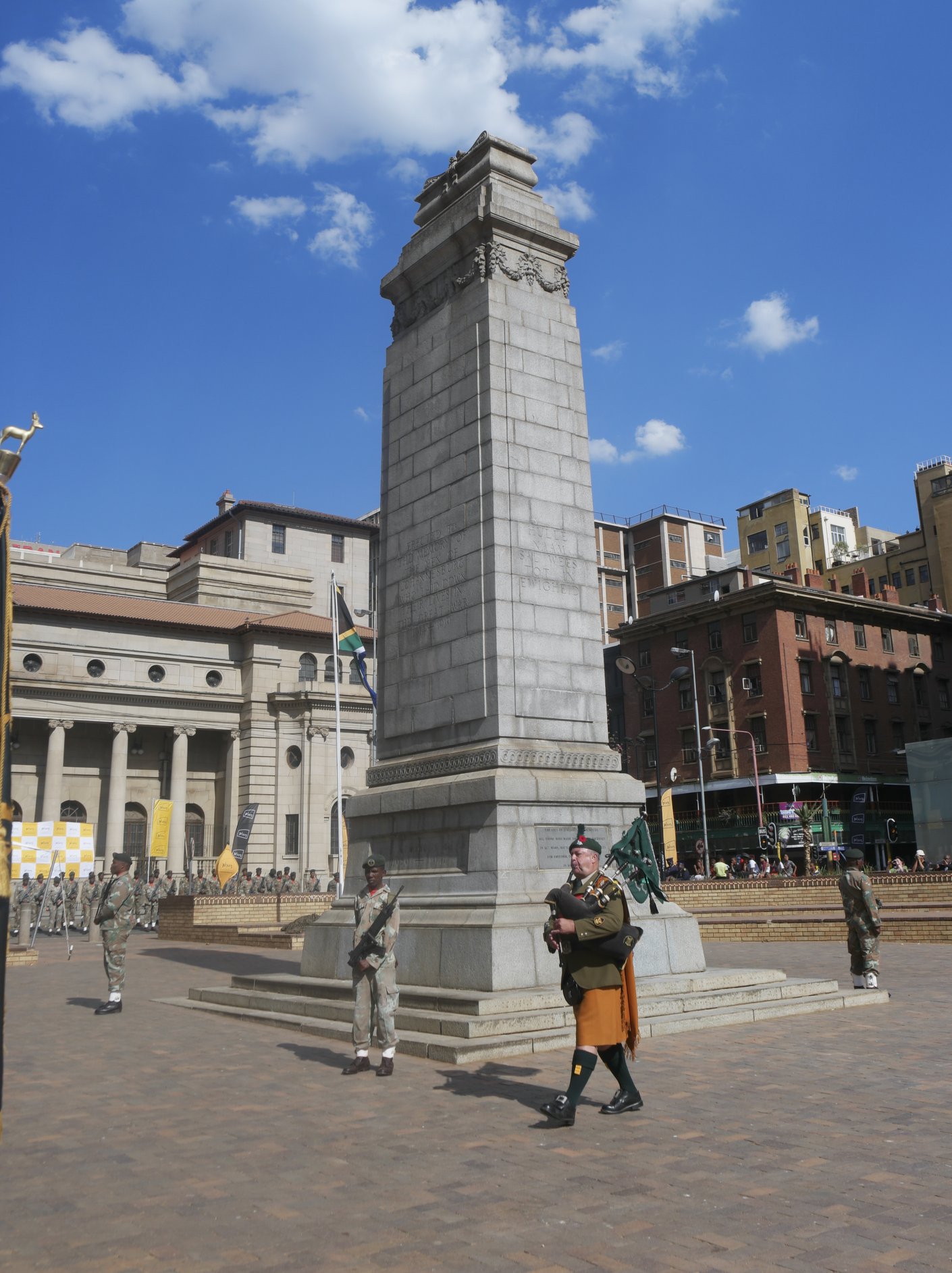
    A bagpiper of the Pipes and Drums of the South African Irish Regiment plays the Lament around the Cenotaph in Johannesburg, Remembrance Sunday 2018. (Photo: SANDF)

    In 1914 the regiment adopted the motto “Quis separabit?” (“Who will separate us?”), during World War II this changed to “Faugh-a-Ballagh” (“Clear the Way”). The regimental cap badge consisted of the Irish harp and the regimental motto. They originally marched to The County Down Militia, this later changed to Killaloe.

    The South African Irish Regiment served with distinction during the Great War and World War II. The regiment transformed throughout the decades, it gained the Freedom of the City of Johannesburg, took part in the Border Wars, and by the early 2000 its members were on deployment with the UN in the Democratic Republic of China.

    Along with their other reserve units, the South African Irish Regimental colours and battle honours will be laid up in parades phased over the coming three-years.

  • Celbridge’s Military Story: Sir Gerald Dease

    Celbridge’s Military Story: Sir Gerald Dease

    Celbridge’s Story: Col. Sir Gerald Richard Dease

    We are starting our work with the Irish Military Heritage Foundation with Celbridge’s Military Story and the story of Colonel Sir Gerald Dease.

    Historian Brendan O’Shea beside the cross in honour of Sir Gerald Dease. (Photo by Wesley Bourke)

    Colonel Sir Gerald Richard Dease K.C.V.O. is a all but forgotten Celbridge figure. His name may be forgotten, but everyday people pass his monument just off the main street. In the grounds of St. Patrick’s church is a Celtic Cross. With a faded inscription it is no wonder that today most people in the area pass the cross taking no notice or questioning why it is there. The cross in many ways highlights how our history can easily pass into memory; apart from the knowledgeable few, most just think the cross is to a local priest.

    In fact, the cross was erected in 1904 by the people of Celbridge in memory of Col. Sir Gerald Richard Dease K.C.V.O., of Celbridge Abbey. We met Celbridge native and European Trustee & Education Officer Ireland, The Western Front Association, Col. (Rtd) Brendan O’Shea to tell the story of Sir Gerald Dease and this chapter of Celbridge’s Military Story.

    Sir Col. Gerald Richard Dease. (Image from: Edward F. Dease: A Complete History Of The Westmeath Hunt From Its Foundation. Dublin: Browne and Nolan, 1898)

    Born on 7 July 1831, Gerald Richard Dease was the third child of Gerald Dease and Elizabeth O’Callaghan of Turbotstown, Mayne, Co. Westmeath. Like many well-off Catholics he was educated at Stonyhurst College, Lancashire, England before returning to Ireland. He married Emily Throckmorton, daughter of Sir Robert George Throckmorton, and Elizabeth Acton, on 25 November 1863. Later he was appointed Justice of the Peace for Counties Kildare and Meath, and became a Director of the Great Southern & Western Railway before being appointed a Director of the Bank of Ireland (the predecessor to the Central Bank) and its Governor between 1890 and 1892. On 27 July, 1881, Dease was appointed Major and Honorary Lieutenant Colonel of the 4th Battalion, Princess Victoria’s (Royal Irish Fusiliers). He also served as the Chamberlain to the Lord-Lieutenant of Ireland and was involved in the organisation of several royal visits to Ireland. For his excellent service he was Knighted in 1897, being made a Companion of the Royal Victorian Order in 1900 and a Knight Grand Cross of the same order on 11 August, 1903. Locally Sir Gerald Dease served on Kildare County Council on several occasions and served as Chairman of the Celbridge Board of Guardians [the Workhouse] (today Colourtrend paint factory) and within both bodies he became an advocate for improved conditions for the poor. He lobbied extensively for the creation of a National University to which Catholics would have full access. It is for these efforts he was most remembered. Gerald and Emily had three children: Eveline Mary Dease, Major William Gerald Dease, and Arthur Joseph Dease. Following his death on 18 October 1903, the people of Celbridge erected the Celtic Cross in recognition of this remarkable man.

    The grave of Gerald and Emily in Tay Lane Cemetery, Celbridge. (Photo by Wesley Bourke)

    This project is support by Kildare County Council.

  • Did the Leinsters Flee At Chunuk Bair?

    Did the Leinsters Flee At Chunuk Bair?

    By Professor Jeff Kildea  

    Cover: Busy scene on beach at Gallipoli 1915. (The Illustrated History of the Great War)

    First published in Autumn 2015 issue.

    In August 1915, the Allies attempted to break the stalemate at Gallipoli by a daring attack on the Sari Bair range above Anzac Cove, including the high point of Chunuk Bair. The attempt failed; and a few months later the Allies, admitting defeat, evacuated the peninsula. The action at Chunuk Bair mostly involved troops from New Zealand. But among the attacking forces were Irish battalions of the 10th (Irish) Division, including the 6th Battalion The Prince of Wales’s Leinster Regiment (Royal Canadians). New Zealand historian Christopher Pugsley, who described the battle in ‘Gallipoli: The New Zealand Story’ (Auckland 1984; 5th edition 2014), refers briefly to the Leinsters, claiming that at a critical time they fled in the face of a Turkish counterattack. But contemporary accounts tell a different story. In this centenary year of the Gallipoli campaign the record should be set straight.

    In the early hours of 8 August 1915, New Zealanders of the Wellington Battalion seized the summit of Chunuk Bair. But theirs was a feeble foothold, for the Turks began to pour a withering fire onto the position and onto Rhododendron Ridge, a spur running from the crest towards the Aegean Sea. The companies of the Wellington Battalion clinging to the summit were soon wiped out, leaving their support companies holding a trench just below the crest.

    For a day and a half the New Zealanders held on until they were relieved by two English battalions on the night of 9-10 August. The next morning the Turks counterattacked in force, sweeping the Englishmen off the summit and rushing down Rhododendron Ridge scattering all before them into the gullies and ravines. The Leinsters, who were part of the 29th Brigade, 10th (Irish) Division, had been brought up in reserve during the night of 9 August. According to Pugsley, in the early hours of 10 August, the Leinsters relieved the Auckland Battalion at the Pinnacle, a feature on Rhododendron Ridge. The Pinnacle was marked by a line of shallow trenches two hundred metres in front of another feature called the Apex, which was the location of the New Zealand Brigade headquarters.

    Describing the Turkish counterattack, Pugsley wrote: ‘Any determined defence might have held, but the 6th Battalion Loyal North Lancashires did not resist but broke and ran, as did the Wiltshires below them. Only the New Zealanders forward showed any fight.’ He then added: ‘Panic spread and the Leinsters at the Pinnacle also fled’. But this statement contradicts the account of the battle given by Major Bryan Cooper in ‘The Tenth (Irish) Division in Gallipoli’ (London, 1918). After describing the overwhelming of the Loyal North Lancashires and the Wiltshires, Cooper wrote: ‘But on the right the Leinsters stood their ground. At last the moment had arrived to which they had so anxiously looked forward. Turk and Irishman, face to face, and hand to hand, could try which was the better man. … In spite of the odds, the two companies in the front line succeeded in checking the attack, and at the crucial moment they were reinforced by ‘B’ and ‘C’ Companies from the support line. … Shouting, they flung themselves into the fray, and drove the Turks back after a desperate struggle at close quarters’.

    Unfortunately, neither Pugsley nor Cooper cite a source for their account of the reaction of the Leinster Regiment to the Turkish counterattack, so it is not possible to identify definitively the evidence upon which each relied. It must also be said that each author has written from a particular, but alternate, perspective.

    Cooper himself served with the 10th (Irish) Division at Gallipoli and his book was written during 1917. Thus, to some degree, his account might be considered self-serving and influenced by patriotic exigencies that would be irrelevant to a disinterested historian writing long after the event. Cooper admits as much in the Preface: ‘It is by no means easy for an Irishman to be impartial, but I have done my best’. Furthermore, Cooper was not present at Chunuk Bair and in writing his book relied on summaries provided by fellow officers of the division. Therefore, his account of the Leinsters does not carry the added weight that might be accorded to an eyewitness. Like Pugsley, he has had to reconstruct the event from the testimony of others.

    Pugsley, on the other hand, is a New Zealander who was writing a national history of the Gallipoli campaign, as the title of his book indicates. He considers the battle for Chunuk Bair to be one of the outstanding feats of arms in his country’s history and, in the conclusion to the chapter on the battle, he extols in quite fulsome and passionate terms the virtues of his countrymen who fought in it. It is understandable, therefore, that Pugsley’s primary research might not have extended to other nationalities and that his writing might not fully or accurately describe their activities. He has neither quoted nor cited Cooper’s book and his bibliography suggests he did not consult the war diaries of the 6th Leinster Regiment or the diaries, correspondence and memoirs of its officers and men.

    So, the question remains: did Pugsley misrepresent the reaction of the Leinsters?

    The Leinster’s war diary does not indicate the battalion’s precise location on Rhododendron Ridge. However, its account of the action on the morning of 10 August 1915, gives no indication that the Leinsters fled:

    ‘TURKS attacked about 06:00, several reaching crest of RHODODENDRON SPUR, a firing line was formed and rushed to the top of RHODODENDRON SPUR where they came under a hot fire. The line was withdrawn about 10 yards from the crest, a machine gun then enfiladed the line from the left inflicting several casualties, a sniper on our left also inflicted losses. Lt Figgis killed. Lt Col Craske wounded in left arm. Attack withdrew about 07:45 and firing line was retired to the trench’.

    Although the war diary contains neither the detail nor the colour of Cooper’s account of the action, it indicates that the Leinsters advanced and then withdrew under orders. The war diary also includes the following: ‘On the 23/8/15 Maj Gen Sir A. Godley KCMG, CB sent for the C.O. and complimented him on the work of the BATTALION on the morning of 10/8/15. He also asked after Lt Col Craske (who was wounded) and said your Colonel has done good work’.


    This hardly suggests that the Leinsters fled the scene. The Australian Official Historian Charles Bean in his account of the battle corroborates Cooper’s account: ‘That night the position at Chunuk Bair was entirely in the hands of the New Army battalions. Birdwood and Godley had by then given up the intention of renewing their assault on the following day, and the new garrison was for the moment to stand on the defensive. The Loyal North Lancashire held both the advanced foothold and the Auckland’s old half-way position at the Pinnacle. The 6th Leinster occupied the Apex. In other words it was the Loyal North Lancashire and not the Leinsters who were at the Pinnacle when the Turks attacked. This is made clear by one of Bean’s maps which shows the Pinnacle and the Apex on Rhododendron ridge occupied by the two units.

    Stretcher bearers removing wounded at Gallipoli, 1915. (Image Imperial War Museum)

    Bean’s account of the Turkish counter attack includes the following:

    ‘Then the North Lancashire broke, both at Chunuk Bair and at the Pinnacle. When the 5th Wiltshire, who had been digging, saw the Turkish line descending upon their right, they also ran back, down the Sazli Dere. …On Rhododendron small parties continued to trickle forward, and an hour later Turks even appeared close above General Johnston’s headquarters at the Apex, where Captain Wallingford is said to have shot two with his revolver. The 6th Leinster and a company of Auckland infantry advanced with bayonets fixed, and relieved the Apex of any further threat’.

    Bean’s account in this regard is supported by that of the British Official History:

     ‘At daybreak on the 10th August, therefore, the British line at the head of Rhododendron Spur was held by three companies of the Loyal North Lancashire (38th Brigade) in the forward trenches, and one company at the Pinnacle. To the right of and far below the Pinnacle were 2½ companies of the 5/Wiltshire (40th Brigade), while the Apex was held by the remnants of the Wellington Battalion, some of the 6/Leinster (29th Brigade) and the massed machine guns of the New Zealand Infantry Brigade.… Suddenly, at 4.45am, dense waves of Turks came pouring over the sky-line. … [Soon] the Turks had captured the Pinnacle, but at that point their advance was stopped by annihilating fire from the New Zealand machine guns at the Apex. The Leinsters were rushed into line to hold the Apex position, and this they succeeded in doing for the rest of the day’.

    Based on the Leinsters’ war diary, the official histories and Cooper, Pugsley’s assertion that the Leinsters fled the Pinnacle during the Turkish counter-attack is wrong. Rather, they did their job in defending the Apex, enabling the New Zealand machine gunners to continue to inflict severe punishment on the Turkish forces, thus preventing them from forcing the British Empire troops off Rhododendron Ridge.

    Dr. Jeff Kildea was Keith Cameron Chair of Australian History at University College Dublin 2014. He is currently working in the Irish Studies Centre, UNSW, Sydney Australia. You can read more on this subject in Dr. Kildea’s book ‘Anzacs and Ireland’, Cork UP, 2007 or by visiting his website: www.jeffkildea.com